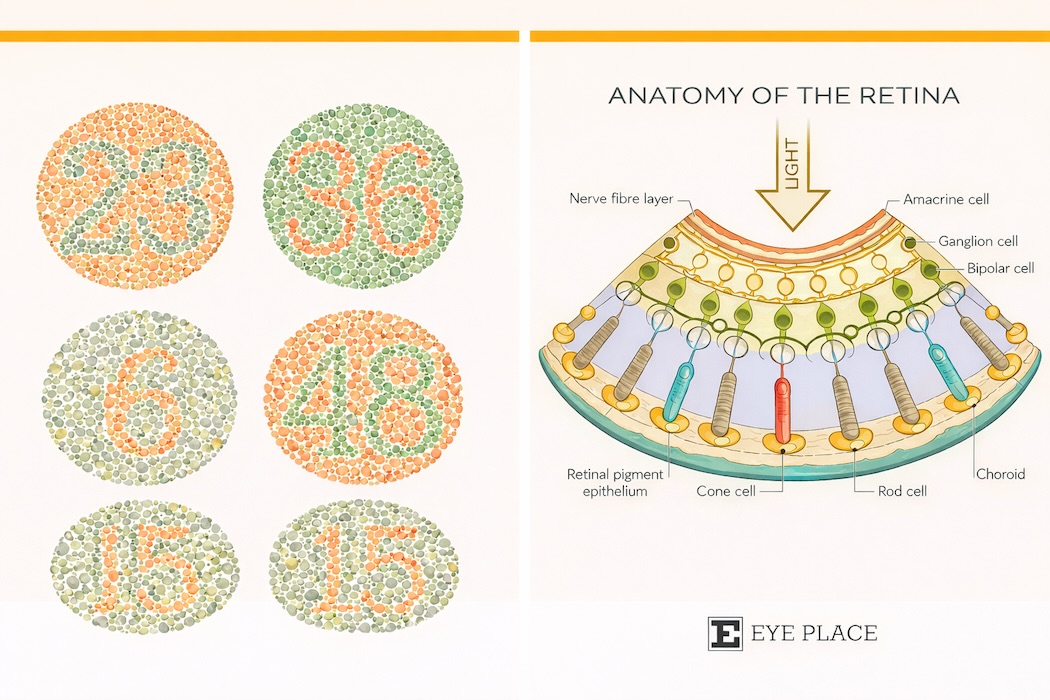
Colour vision testing checks how well your eyes and brain can tell the difference between colours. Many people assume colour vision problems are rare or obvious. In reality, many adults and children have never been tested and do not realise there is an issue.
Colour vision affects everyday tasks like driving, reading signs, recognising warning lights, choosing food, and working safely. In 2026, colour vision testing remains an important part of understanding overall eye health and visual function.
Some colour vision problems are present from birth
Others can develop later due to eye or health conditions
Testing is quick, simple, and non-invasive
Early detection supports safety, career planning, and eye health monitoring
What is colour vision?
Colour vision is your ability to see and tell the difference between colours, particularly reds, greens, blues, and yellows. This process relies on specialised cells in the retina called cones, which send colour information to the brain.
If these signals do not work properly, colours may appear muted, similar to one another, or difficult to identify accurately.
What is colour vision deficiency?
Colour vision deficiency is when someone has difficulty distinguishing certain colours. It does not usually mean seeing only in black and white. Most people with colour vision deficiency still see colour, but differently from others.
The most common type affects red and green colours. Blue and yellow difficulties are less common.
Many people adapt from a young age and may not realise their colour vision differs from those around them.
Is colour vision deficiency common?
Yes. Colour vision deficiency affects:
Around 1 in 12 males
Around 1 in 200 females
It is more common in males because the most frequent types are inherited through the X chromosome.
Because colour vision deficiency often causes no pain or obvious vision loss, many people are never tested unless there is a specific reason.
Inherited colour vision deficiency vs acquired colour vision changes
Inherited colour vision deficiency
Present from birth
Usually stable throughout life
Most commonly affects red and green colour perception
Often discovered during childhood or later through testing
Acquired colour vision changes
Develop later in life
Can affect one or both eyes
May worsen over time
Sometimes linked to eye disease, general health conditions, or medication use
Identifying whether a colour vision issue is inherited or acquired helps guide further eye health checks when needed.
Can colour vision problems develop later in life?
Yes. Not all colour vision issues are inherited.
Colour vision changes can occur due to:
Eye conditions affecting the retina or optic nerve
Diabetes and other systemic health conditions
Certain medications
Head injury
Age-related changes in eye health
When colour vision changes develop later in life, they can sometimes be an early sign of an underlying eye or nerve issue, even before other symptoms appear.
Why colour vision testing is important
Colour vision testing is not just about identifying a condition. It plays a role in several important areas.
Safety
Everyday safety often relies on colour recognition, including traffic lights, warning labels, indicator lights, and electrical wiring.
Work and career planning
Some careers rely heavily on accurate colour vision, such as:
Electrical and trade roles
Aviation and transport
Defence and emergency services
Certain technical, medical, and laboratory roles
Early testing helps avoid unexpected issues later when career pathways are already established.
Monitoring eye health
Changes in colour vision can sometimes indicate eye or nerve conditions before changes in visual clarity occur.
When should colour vision be tested?
Colour vision testing is useful at different life stages, including:
At school entry
During teenage years
Before choosing certain careers or trades
As part of routine adult eye exams
If colours suddenly appear different or dull
Even if colour vision was checked in childhood, repeat testing can still be relevant later in life.
How colour vision testing works
Colour vision testing is quick and non-invasive. It is commonly included as part of a thorough eye examination.
Common tests include:
Pattern plate tests where numbers or shapes appear within coloured dots
Arrangement tests where coloured tiles are placed in order
These tests help determine the presence, type, and severity of colour vision difficulties.
Can colour vision deficiency be treated?
Inherited colour vision deficiency cannot be cured. However, understanding how colour vision works allows people to adapt safely and confidently in daily life and work.
For acquired colour vision changes, treating the underlying eye or health condition may improve colour vision in some cases.
Regardless of the cause, knowing about a colour vision issue supports better decision-making and eye care planning.
Colour vision testing at E Eye Place
At E Eye Place, colour vision testing is included as part of a thorough eye examination when appropriate. Results are explained clearly and related to your daily activities, work needs, and overall eye health.
Testing is quick, comfortable, and focused on helping you understand how your vision functions, not just what the results show.
If you have never had your colour vision tested, or if you have noticed changes in how colours appear, booking an eye exam is a simple place to start.
Stephanie is an owner optometrist, researcher and educator. She has held clinical, teaching and research roles in Australia and overseas, and has extensive training and clinical experience. Stephanie is also the head optometrist at E Eye Place, on top of this, she is also currently a PhD candidate at UNSW. Dr Stephanie Yeo Optometrist BOptom (HC1) GradCertOcTher DOPT (Merit) CO Ophthalmic Medicines Prescriber.