What Is Presbyopia and Why Does It Happen After 40?
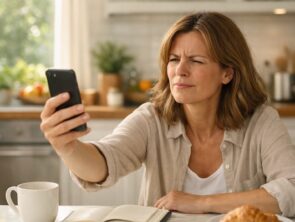
You pick up your phone to check a message and hold it a little further away than you used to. You find yourself squinting at a restaurant menu. You finally cave and buy a pair of reading glasses from the pharmacy rack and they actually help.
If any of this sounds familiar, there is a good chance you are experiencing presbyopia. It is one of the most common vision changes in the world, yet it catches many people completely off guard, usually somewhere around their 40th birthday.
In this article, we explain exactly what presbyopia is, why it happens, and what your best options are for clear, comfortable vision at every distance.
QUICK SUMMARY
Presbyopia is the gradual loss of near vision that comes with age
It affects almost everyone from around age 40 onwards
It is not a disease, just a natural change in the eye’s lens
It is different from long-sightedness, even though symptoms can feel similar
Several correction options are available, including reading glasses, progressives and contact lenses
A comprehensive eye test is the best first step
What Is Presbyopia?
Presbyopia (pronounced prez-bee-OH-pee-ah) is the gradual loss of the eye’s ability to focus on close objects. The word comes from the Greek for “old eye”, though presbyopia is not a disease and it is not a sign of anything going wrong. It is simply a natural part of how the human eye ages.
Most people notice it between the ages of 40 and 45. By 50, it is almost universal. By 65, the focusing ability of the eye has usually reduced to a fraction of what it was at age 20.
Presbyopia is different from short-sightedness (myopia), long-sightedness (hyperopia), or astigmatism, all of which relate to the shape of the eye. Presbyopia is specifically about the lens inside your eye losing flexibility over time.
Why Does It Happen After 40?
To understand presbyopia, it helps to understand how the eye focuses in the first place.
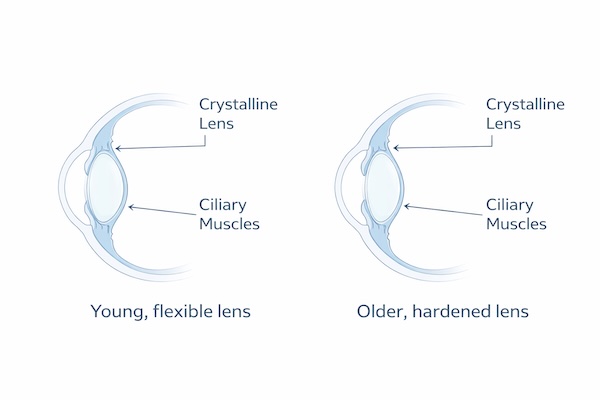
Behind your pupil sits a small, flexible structure called the crystalline lens. When you look at something close up, like a book, a phone, or a price tag, tiny muscles called ciliary muscles squeeze the lens to make it rounder and more curved. This allows the eye to bend light more sharply and bring the near object into focus. The process is called accommodation.
In a young eye, this happens instantly and effortlessly. The lens is soft, pliable, and responds quickly.
As you age, the proteins inside the lens gradually harden. The lens becomes stiffer and less able to change shape, even when the ciliary muscles are doing their job. The result is that near objects become progressively harder to focus on, no matter how hard you try.
The timeline typically looks like this:
In your 20s and 30s: No symptoms. Accommodation works easily.
Around 40 to 45: You may notice small print is harder to read in dim light.
Around 45 to 50: Reading at arm’s length becomes difficult.
Around 50 to 55: Without correction, close work becomes genuinely uncomfortable.
60 and beyond: The natural lens has very little flexibility remaining.
Presbyopia affects everyone, even people who have never needed glasses in their life. People who were previously long-sighted often notice the effects of presbyopia earlier, while short-sighted people may find they can still read without their distance glasses for a few extra years, though they will still develop presbyopia eventually.
What Are the Symptoms of Presbyopia?
The signs of presbyopia tend to be gradual and easy to dismiss at first. Common symptoms include:
Holding books, phones, or menus further away to see them clearly
Blurry vision when reading at a normal distance
Needing more light to read comfortably than you used to
Eye strain or headaches after prolonged close work
Fatigue when reading, sewing, or doing detailed tasks
Difficulty switching focus between near and far objects
If you have been experiencing any of these, it is worth booking a comprehensive eye test. Presbyopia is very straightforward to diagnose and manage and the earlier you address it, the more comfortable your day-to-day life will be.
Presbyopia vs Long-Sightedness: What Is the Difference?
This is a very common source of confusion. Both presbyopia and hyperopia (long-sightedness) cause difficulty seeing things up close, but they have different causes.
Long-sightedness is caused by the eyeball being too short, or the cornea being too flat, so light focuses behind the retina instead of on it. It is usually present from birth and can affect both distance and near vision.
Presbyopia is caused by the lens hardening with age. It affects near vision specifically and gets progressively worse as you get older, regardless of whether you were long-sighted, short-sighted, or had perfect vision before.
Someone who was long-sighted all their life will generally notice presbyopia earlier and more strongly. Someone who was short-sighted may find their near vision actually improves slightly without their distance glasses as presbyopia develops, though this is a temporary and imperfect workaround.
A comprehensive eye examination is the only reliable way to determine exactly what is happening with your vision.
What Are Your Options for Presbyopia?
The good news is that presbyopia is very manageable. The right option depends on your lifestyle, your overall prescription, and your visual needs.
1. Reading Glasses (Over-the-Counter)
The most immediate and accessible solution is a pair of reading glasses from a pharmacy. These are inexpensive, readily available, and work well for people who only need help with near tasks and have otherwise healthy distance vision.
The downside is that over-the-counter reading glasses are not customised to your eyes. Both lenses have the same power, the optical centres may not align with your pupils, and the prescription is a best guess rather than a precise measurement. For occasional use this may be fine, but for regular reading or screen work a proper prescription is usually more comfortable.
Worth knowing: Ready-made reading glasses are a useful short-term fix, but they can cause eye strain if the power does not match your actual prescription. Read our post on ready-made reading glasses for more detail.
2. Prescription Reading Glasses
A pair of reading glasses made to your exact prescription, with lenses centred to your pupil distance, will almost always be more comfortable and effective than over-the-counter alternatives. These are ideal if your only visual difficulty is near tasks.
3. Progressive Lenses (Multifocals)
For people who need correction at multiple distances, both near and far, or near and intermediate such as a computer screen, progressive lenses are often the most practical solution. A single pair of glasses provides clear vision at all distances, with a gradual change in lens power from top to bottom.
Progressive lenses take a little adjustment when you first start wearing them, but most people adapt within a few weeks. Modern progressive lens designs, including ZEISS progressive lenses, offer very wide, comfortable vision zones with minimal distortion.
4. Bifocals
Bifocals have two distinct zones of focus, distance at the top and near at the bottom, with a visible line between them. While progressives have largely replaced bifocals for most people, bifocals are still a solid option for some patients, particularly those who find the progressive adaptation challenging.
5. Contact Lenses for Presbyopia
Multifocal contact lenses are available and work well for many people with presbyopia. There is also an approach called monovision, where one eye is corrected for distance and the other for near vision. Both options are worth discussing with your optometrist, as they depend heavily on your individual prescription and visual preferences.
6. Refractive Surgery
Surgical options including LASIK, lens replacement surgery, and presbyopia-correcting implants exist for those who prefer a non-glasses or non-contact approach. These are not suitable for everyone and require a thorough assessment by an eye specialist.
Can Presbyopia Be Prevented or Reversed?
Unfortunately, no. Presbyopia is a structural change in the lens driven by ageing and it cannot be prevented or reversed by diet, eye exercises, or lifestyle changes. Any product claiming to reverse presbyopia should be approached with caution.
What you can do is manage it effectively with the right correction and ensure your eyes are examined regularly so your prescription stays accurate as presbyopia progresses. Most people find their reading prescription changes every couple of years, particularly in their 40s and 50s.
When Should You See an Optometrist?
If you are noticing any difficulty reading small print, or you have been relying on pharmacy reading glasses for a while, it is time for a comprehensive eye examination.
An optometrist can:
Accurately measure your prescription for both near and distance vision
Rule out other conditions that can affect near vision, such as cataracts or macular degeneration
Recommend the lens type and correction approach that suits your lifestyle
Monitor your prescription over time as presbyopia progresses
At E Eye Place, our optometrists take the time to understand how you use your vision day to day, whether you spend long hours at a computer, read frequently, drive at night, or play sport, so we can recommend the most comfortable and practical solution for you specifically. If you are over 40 and noticing changes in your near vision, do not put it off. Presbyopia is completely normal, easy to manage, and much more comfortable when it is properly corrected.
Book Your Eye Test at E Eye Place
Our clinics in Port Coogee and Shelley (Newing & Co) offer comprehensive eye examinations for adults of all ages. Book online or give us a call today.
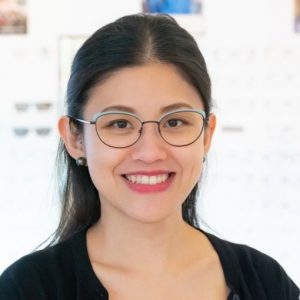
Stephanie is an owner optometrist, researcher and educator. She has held clinical, teaching and research roles in Australia and overseas, and has extensive training and clinical experience. Stephanie is also the head optometrist at E Eye Place, on top of this, she is also currently a PhD candidate at UNSW. Dr Stephanie Yeo Optometrist BOptom (HC1) GradCertOcTher DOPT (Merit) CO Ophthalmic Medicines Prescriber.